Yunpu Zeng

Ph.D. Student in Industrial Engineering
Georgia Institute of Technology
Healthcare Operations
Disease Modeling
Microsimulation
GitHub · ORCID · LinkedIn
Research Interests
- Healthcare Operations
- Disease Modeling & Microsimulation
- State-Transition Modeling
- Cost-Effectiveness & Intervention Evaluation
- Public Health Analytics
- Data Analytics & Simulation
Research
Population-Level Modeling of Long COVID Burden
Ongoing Research · 2025–Present
Long COVID has created a substantial and persistent public health burden, but estimating its population-level impact remains challenging because reported COVID-19 cases do not fully capture the true scale of acute infections.
My current research develops a population-level modeling framework for Long COVID that connects acute COVID-19 infection dynamics with post-acute disease progression and longer-term symptom burden.
A major focus of this work is integrating wastewater-informed estimates of SARS-CoV-2 transmission with a state-transition framework for Long COVID. By combining population-level infection estimates with heterogeneous post-acute symptom trajectories, the model is designed to better characterize how Long COVID burden accumulates and evolves over time.
The framework incorporates longitudinal symptom patterns informed by clinical evidence and follows individuals through different trajectories of persistent symptoms, improvement, recovery, or continued disease burden. These individual-level trajectories are then aggregated to estimate population-level outcomes such as Long COVID prevalence and active disease burden over calendar time.
Ultimately, this work aims to provide a more comprehensive understanding of the long-term consequences of COVID-19 and to support future evaluation of healthcare needs and public health interventions.
📄 Manuscript
“Population-Level Burden of Long COVID in the United States: A Wastewater-Informed Modeling Study”
Manuscript submitted to Nature Communications.
🎤 Upcoming Presentation — 2026 INFORMS Annual Meeting
Session: Epidemic Modeling and Public Health Response
Date: Wednesday, November 4, 2026
Time: 9:30–10:45 AM
Location: Moscone South 105, San Francisco
Drinking-Behavior-Driven Microsimulation for Alcohol-Related Disease Progression
Ongoing Research Program · 2024–Present
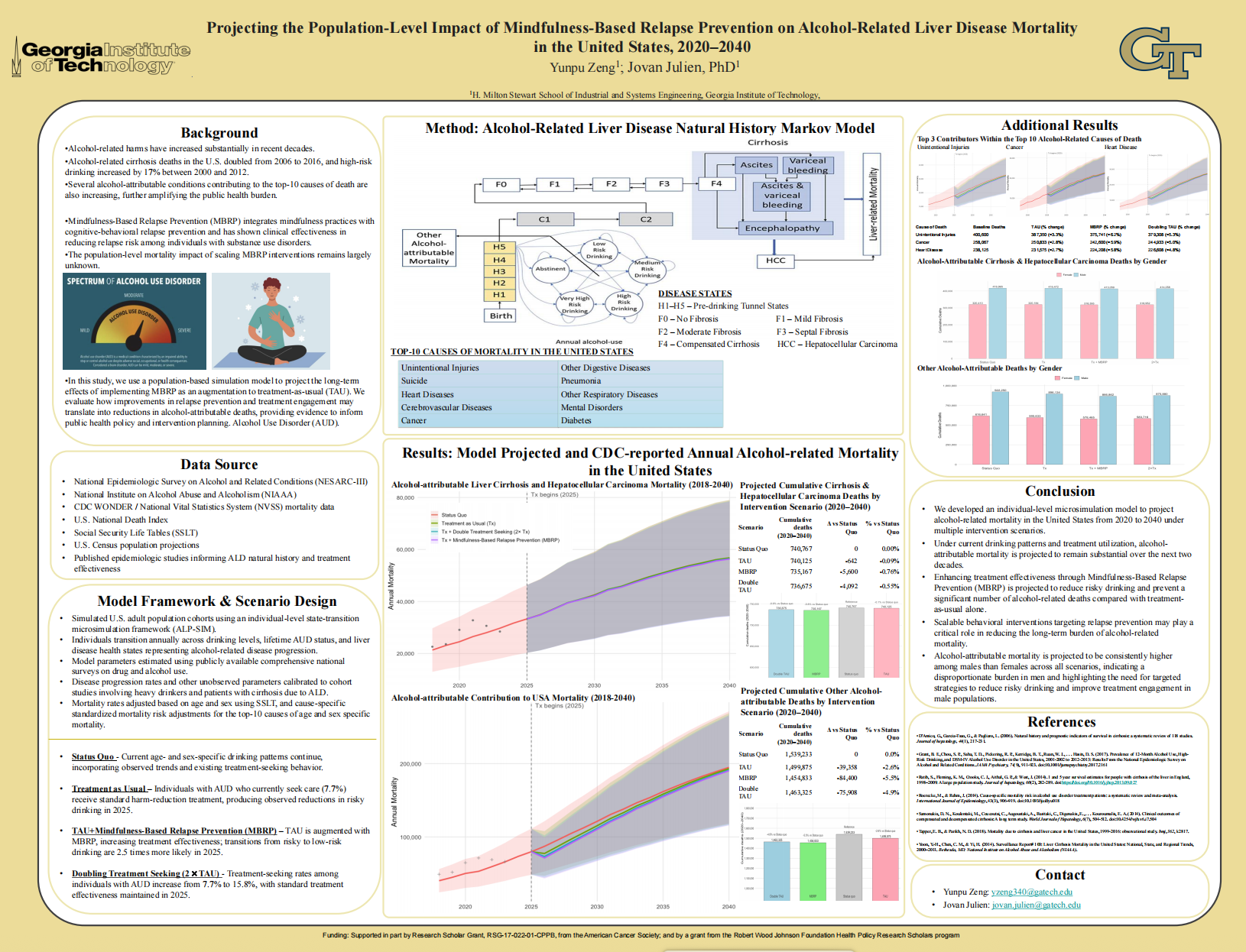
This is an ongoing research program centered on an individual-level microsimulation framework that links drinking behavior, chronic disease progression, mortality, and healthcare interventions.
Rather than treating alcohol-related diseases as isolated outcomes, the framework follows individuals across heterogeneous drinking-risk states and disease trajectories over time. It is designed to study how changes in alcohol consumption influence long-term health outcomes across U.S. birth cohorts and to evaluate interventions aimed at reducing alcohol-related disease burden.
The framework has continued to evolve as new disease pathways, mortality risks, and intervention strategies are incorporated.
Cirrhosis Progression & Alcohol-Related Mortality
I developed a natural-history state-transition model for alcohol-related cirrhosis, linking drinking-risk states with progressive liver disease pathways.
The model was subsequently extended beyond liver-specific outcomes to incorporate a broader set of alcohol-attributable causes of death, including:
- Cancer
- Cardiovascular disease
- Unintentional injuries
- Other competing mortality risks
By integrating drinking behavior, liver disease progression, and competing alcohol-related mortality pathways within the same microsimulation framework, this extension provides a more comprehensive representation of the long-term population health burden associated with alcohol use.
The model is used to examine how heterogeneous drinking patterns and disease trajectories contribute to mortality over time and across different U.S. birth cohorts.
Esophageal Cancer Progression
The drinking-behavior-driven microsimulation framework was extended to study alcohol-related esophageal squamous cell carcinoma.
I modeled disease progression across a sequence of health states, including:
- Normal tissue
- Dysplasia
- Early-stage esophageal cancer
- Late-stage esophageal cancer
- Mortality
The model was used to evaluate long-term cancer incidence and mortality across U.S. birth cohorts while preserving heterogeneous drinking behaviors within the underlying simulation framework.
This extension demonstrated how the same drinking-behavior structure could be adapted to different alcohol-related disease pathways rather than being limited to liver disease alone.
Alcohol-Use Reduction Interventions
The current phase of the research program focuses on evaluating interventions designed to reduce alcohol consumption and its downstream health consequences.
Rather than modifying disease progression directly, the intervention framework acts on transitions across drinking-risk states, allowing treatment effects to propagate through subsequent disease and mortality pathways over time.
Current applications include:
- Mindfulness-based interventions
- Pharmacologic interventions for alcohol use disorder
- Semaglutide-based alcohol-use reduction
- Alternative treatment-duration strategies
- Long-term effects on alcohol-related disease burden and mortality
A major focus of this work is understanding how the timing, duration, and effectiveness of an intervention influence population-level outcomes.
The framework also provides a foundation for future evaluation of intervention value through cost-effectiveness analysis.
Intra-Subject Respiratory Motion Modeling Using a Diffeomorphic Approach
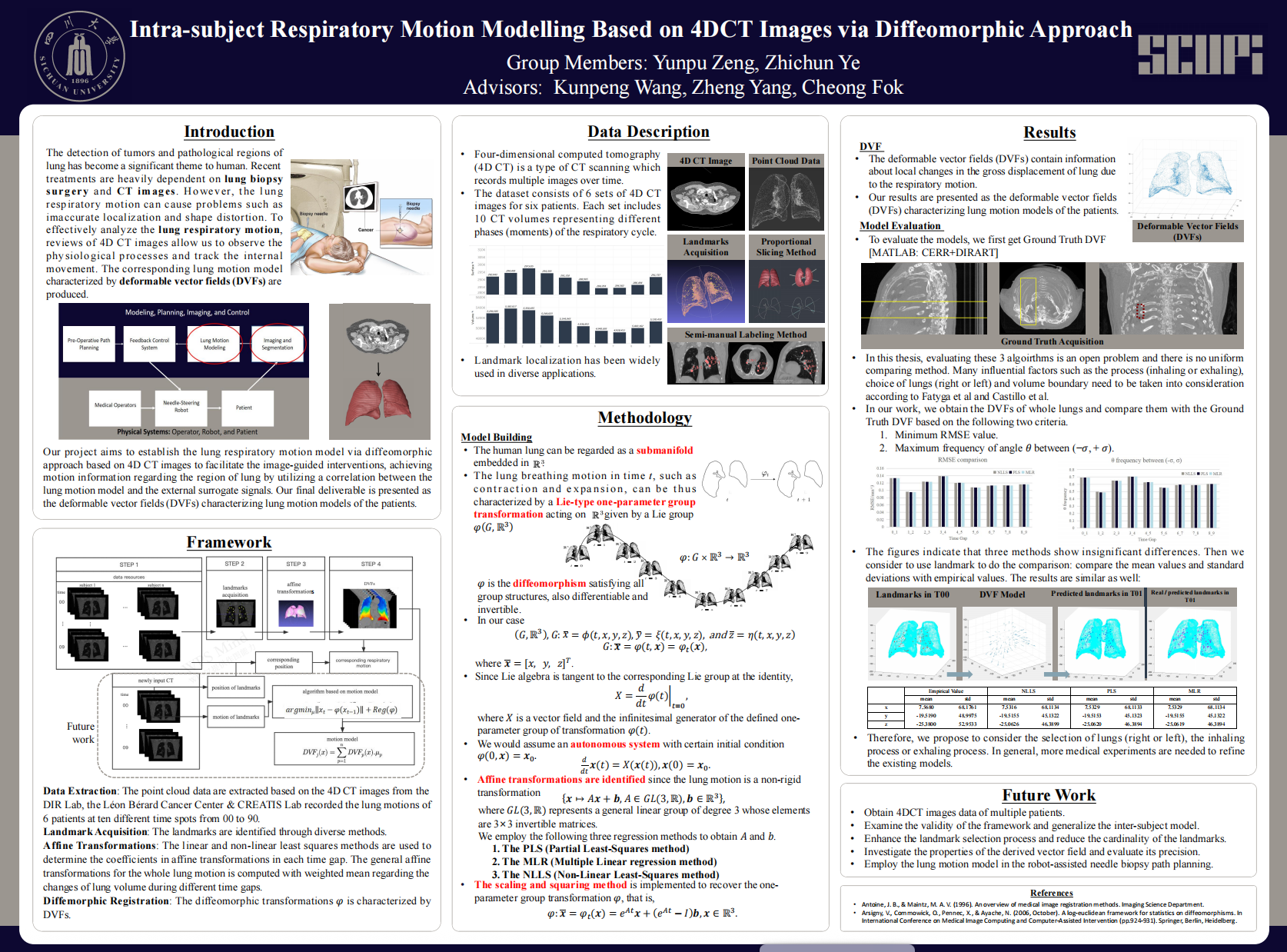
Respiratory motion creates an important challenge for image-guided lung interventions. A conventional static CT scan captures the anatomy at only one moment in the respiratory cycle, while lung tissue, vessels, and potential biopsy targets continuously move as a patient breathes.
In this project, we developed a computational framework for modeling patient-specific respiratory motion from 4D CT images. The goal was to reconstruct the dynamic motion of lung regions across respiratory phases and provide more informative motion estimates for applications such as image-guided lung biopsy.
The modeling pipeline included:
- Extracting anatomical information from 4D CT images across different respiratory phases
- Constructing point-cloud representations of lung structures and identifying anatomical landmarks for motion correspondence
- Using affine transformations to characterize global respiratory motion between image phases
- Fitting correspondence models using both linear and nonlinear least-squares optimization
- Representing local tissue deformation using deformable vector fields (DVFs)
- Applying a diffeomorphic modeling framework to preserve smooth and anatomically meaningful transformations
- Comparing the derived motion fields with reference vector fields to evaluate motion-model accuracy
A key part of the project was developing and validating DVFs that describe how individual regions of the lung move during respiration. These motion fields provide a continuous representation of tissue displacement and can potentially help estimate the location of anatomical targets when direct imaging information is limited.
The project began as my undergraduate senior project at Sichuan University–Pittsburgh Institute and later developed into a peer-reviewed conference publication.
Airway Tree Segmentation Using U²-Net
This project focused on automatic airway tree segmentation from chest CT scans, with the goal of accurately extracting both the main trachea and smaller peripheral bronchi from three-dimensional medical images.
We developed a deep-learning segmentation pipeline based on U²-Net, a nested U-shaped convolutional neural network architecture. The model was trained using multi-site CT scans from the ATM'22 Airway Tree Modeling Challenge, which provided 299 annotated CT scans for training and 50 additional scans for validation.
A major challenge in airway segmentation is the strong class imbalance between airway and non-airway voxels, since airway structures occupy only a small portion of a chest CT scan. To address this, we trained the U²-Net using the Dice loss function rather than conventional binary cross-entropy, allowing the model to place greater emphasis on accurately identifying small airway structures.
The workflow included:
- CT intensity normalization and preprocessing to improve training efficiency and feature extraction
- A two-level nested U²-Net architecture with Residual U-blocks (RSUs) for multi-scale feature learning
- Multiple side-output saliency probability maps combined into a final airway probability map
- Dice-loss-based end-to-end optimization to address airway/non-airway class imbalance
- Thresholding and connected-region post-processing to remove spurious non-airway regions and refine the final airway tree
The resulting model demonstrated good segmentation of the trachea and major bronchial branches, with generally strong connectivity and anatomical accuracy on the validation CT scans, while also highlighting the greater difficulty of preserving connectivity in smaller peripheral bronchi.
Flu Hospitalization Forecasting
This project focused on probabilistic forecasting of seasonal influenza hospitalizations by combining epidemiological modeling with real-time data sources, including Google search trends.
I worked with a compartmental SIRS model together with an Extended Kalman Filter (EKF) to improve state estimation and dynamically update hospitalization forecasts as new observations became available.
The broader forecasting framework explored multiple modeling approaches, including:
- Naive forecasting strategies
- Compartmental epidemiological models
- Statistical time-series methods
- Machine learning approaches
- Temporal deep-learning models
- Multivariable temporal forecasting models
My work focused particularly on integrating the SIRS model with the EKF for real-time data assimilation, allowing the latent epidemic states to be continuously updated while accounting for uncertainty and noisy observations.
The project also involved processing and correcting CDC flu hospitalization data to support more reliable forecasting and evaluation.